
Composite panels fail for two reasons: bad core selection and worse bonding. In fifteen years of supplying sandwich panels for commercial construction and specialized vehicles, I’ve seen delamination destroy projects that looked perfect on paper. The difference between a panel that lasts twenty years and one that fails in two usually comes down to understanding foam core vs honeycomb at a molecular level, and knowing which FRP manufacturing process actually locks those layers together permanently.
Most composite panels guides stop at “foam is cheaper, honeycomb is lighter.” That’s not enough information to make a six-figure procurement decision. So I’m going to walk through what actually matters: how core density affects compressive strength under real environmental loads, why continuous lamination produces more consistent panels than batch pressing, and which failure modes you should be testing for before you sign off on a shipment.
Facilities running 1,700 square meters daily have enough throughput to catch process drift early. That’s the kind of manufacturing scale that prevents the batch-to-batch inconsistencies that cause field failures.
By the end of this guide, you’ll know exactly which questions to ask your supplier about adhesive bonding, thermal expansion compatibility, and long-term structural integrity, and which red flags mean you should walk away from the deal entirely.
Anatomy of Composite Panels and Cores
The structural logic of any composite panel is simple: outer skins resist bending loads in tension and compression, while the inner core separates those skins to maximize stiffness and carries shear stress. Change either element, and the entire panel behavior shifts.
Outer Skins vs. Inner Cores: Where the Real Engineering Happens
Sandwich panel design follows the same principle as an I-beam. The two outer skins act as the flanges, resisting tensile and compressive forces during bending. The core functions as the web, maintaining distance between the skins and transferring shear loads between them. The wider that core spacing, the higher the moment of inertia, and the stiffer the panel becomes without adding significant weight.
Skin material selection directly determines what loads the panel can handle and what environment it can survive. Fiberglass reinforced sheets, for example, provide excellent corrosion resistance and electrical insulation, making them the standard for marine and chemical processing enclosures. Aluminum and steel facings, on the other hand, offer higher rigidity per unit thickness and are preferred in structural building envelopes and truck body applications where flatness and impact resistance are non-negotiable.
- GRP/FRP Skins: Gelcoat options for UV and moisture resistance; continuous fiberglass reinforced thermoplastic variants offer lighter weight and higher impact resilience.
- CFRT Skins: Continuous fiber reinforced thermoplastic sheets providing high strength-to-weight ratios with recyclability advantages.
- Aluminum and Steel Facings: Pre-painted or coated options delivering superior flatness and weather resistance for exterior wall cladding and vehicle panels.
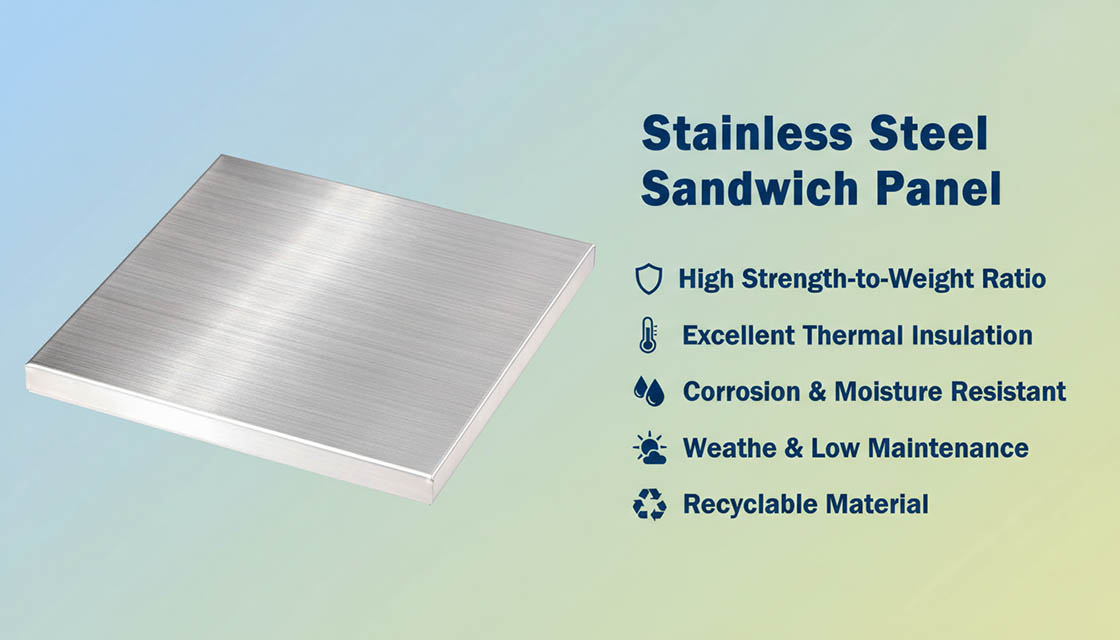
- Specialty Facings: Stainless steel, Aluzinc, HDPE, and plywood options for niche applications requiring specific chemical, thermal, or structural properties.
The core material, however, is where most procurement decisions should be won or lost. A panel with premium aluminum skins but an under-specified core will delaminate under cyclic loading just as fast as a poorly bonded budget panel.
Core density, shear modulus, and compressive strength are the three metrics that dictate long-term structural survival. From our production floor experience, mismatched skin-core adhesive compatibility causes more field failures than any raw material defect: we test bond integrity under temperature cycling before approving any new material combination.
MCM vs. ACM: Definitions That Affect Specification and Procurement
These two acronyms appear throughout architectural and industrial specifications, and confusing them leads to costly compliance failures. ACM stands for Aluminum Composite Material. It refers specifically to panels constructed with two thin aluminum sheet facings bonded to a core, typically polyethylene (LDPE) or a fire-retardant mineral core. ACM panels dominate commercial cladding, signage, and architectural facade applications. The aluminum skins are usually pre-finished with PVDF or FEVE coatings for weatherability.
MCM stands for Metal Composite Material. This is the broader category. While ACM uses aluminum facings exclusively, MCM encompasses panels with any metal skin (steel, stainless steel, zinc, copper, or titanium) bonded to a core substrate. Every ACM panel is an MCM panel, but not every MCM panel qualifies as ACM. This distinction matters when reading project specifications: an architect calling for “MCM cladding” may accept steel-faced panels, while an “ACM-only” spec legally restricts the material to aluminum facings.
For procurement teams sourcing from Chinese manufacturers, the practical difference shows up in pricing tiers and lead times. ACM production lines are standardized across most factories, including our own, with predictable output rates. MCM variants using steel, stainless steel, or Aluzinc facings often require adjusted lamination parameters: different adhesive chemistries, modified press temperatures, and longer curing cycles. These adjustments affect both unit cost and minimum order quantities, so specifying MCM when ACM would suffice unnecessarily inflates project budgets.
Fire performance further separates the two categories. ACM panels with LDPE cores offer no meaningful fire resistance and are restricted to low-rise or non-critical applications in most jurisdictions. Fire-rated ACM uses mineral-filled cores containing compounds like magnesium hydroxide, which can resist flame spread for up to two hours.
MCM panels with steel or stainless steel facings inherently provide better fire performance at the skin level, but the core still governs the overall fire rating. Specifiers must verify the core composition independently of the facing material. Assuming that metal-faced automatically means fire-safe is a dangerous and expensive error.
Core Material Types: Honeycomb vs Foam
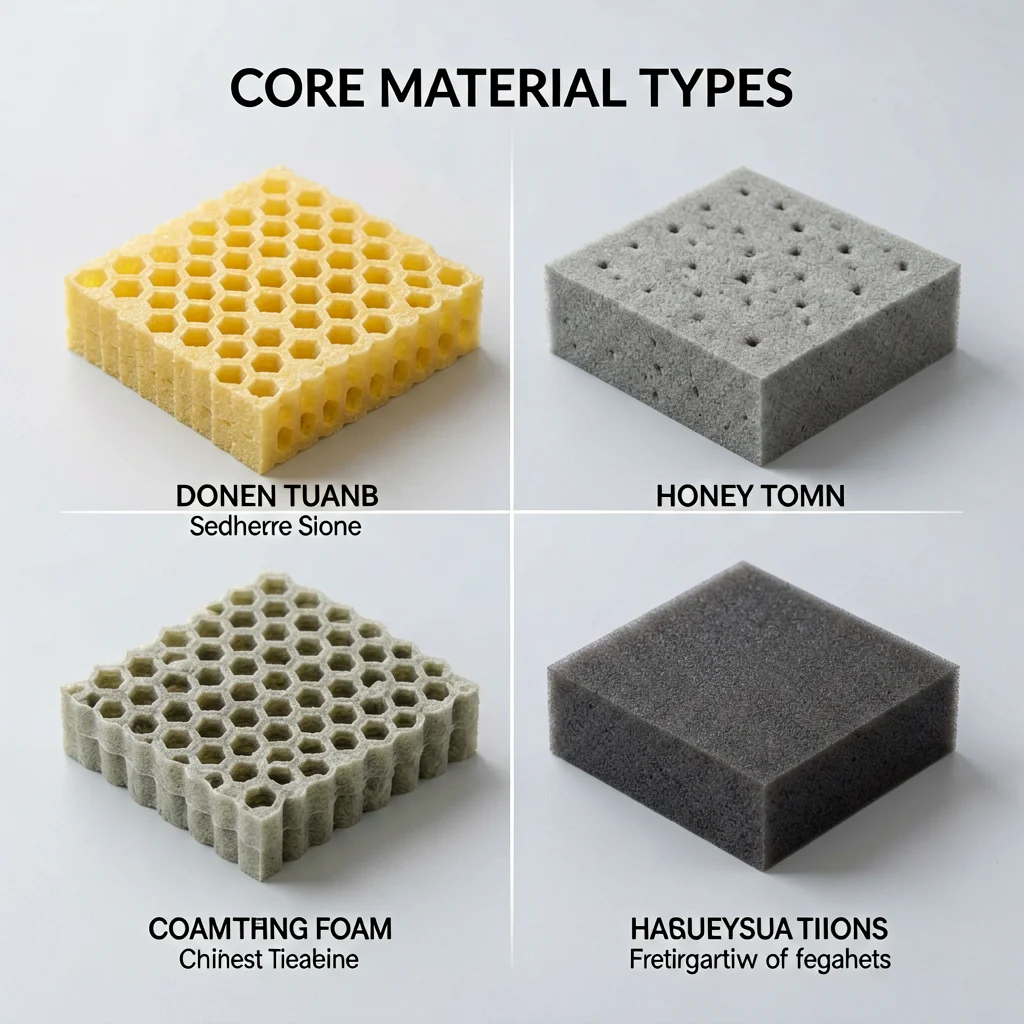
Honeycomb cores win on sheer stiffness-to-weight ratio and fire resistance. Foam cores win on thermal insulation, ease of fabrication, and cost efficiency. The wrong choice either wastes budget or invites field failure.
Aluminum Honeycomb Cores
Aluminum honeycomb is exactly what it sounds like: a hexagonal cell structure expanded from thin aluminum foil. The geometry mimics natural beehives, which gives it an exceptional strength-to-weight ratio. In sandwich panel construction, it acts as the shear-transfer bridge between two rigid face sheets, carrying lateral loads while adding almost negligible mass.
The critical advantage shows up in fire scenarios. Aluminum honeycomb withstands temperatures exceeding 400°C before approaching structural limits, with a melting point around 660°C. It produces zero toxic off-gassing during thermal exposure. This is not a marginal improvement over polymer-based cores. It is a categorical difference. Polyurethane (PU) foam, by contrast, begins to degrade at roughly 100°C and releases hydrogen cyanide when it burns, failing SOLAS fire codes for main accommodation areas on marine vessels (Source: Magellan Marine Technical Comparison).
- Compressive Strength: Significantly higher than foam cores at equivalent density, making it the preferred choice for flooring, bulkheads, and structural partitions.
- Shear Performance: The continuous cell walls provide uniform load distribution across the panel, reducing stress concentrations that trigger delamination.
- Recyclability: Pure aluminum core is fully recyclable, which matters increasingly for manufacturers facing end-of-life material regulations.
- Limitation: Thermal insulation is poor compared to foam. If insulation is a primary requirement, aluminum honeycomb alone will not meet spec without additional thermal breaks.
In our facility, we produce aluminum honeycomb panels paired with GRP, aluminum, and ACP face sheets. The bonding process is where most failures originate: poor adhesive distribution or contaminated foil surfaces create voids that propagate under cyclic loading. We address this by running continuous lamination with monitored resin spread rates, which keeps bond-line consistency within tight tolerance across the full 1,700+ square meters of daily output.
Cost is the sticking point. Standard aluminum honeycomb panels run between $15 and $25 per square meter on the wholesale market, which sits above most foam-core options. For marine accommodation, aviation, and high-spec architectural applications, that premium pays for itself in fire compliance and structural longevity. For standard wall cladding or insulated enclosures, it is usually over-engineered spend.
Insulated Foam Cores
Foam cores occupy the volume-play segment of sandwich panel construction. They trap gas within closed or open-cell structures, giving them thermal conductivity values that honeycomb simply cannot match. When the engineering priority is temperature control (refrigerated truck bodies, cold chain logistics, building envelopes), foam is the rational starting point.
Not all foam is equal. The material selection within this category changes performance dramatically, and confusing one for another is a common sourcing error that leads to costly field problems.
- PET Foam: Good dimensional stability, recyclable, and processes well with vacuum infusion. We use PET extensively in RV wall and roofing panels where moderate temperature resistance and weight savings are both required.
- PVC Foam: Closed-cell structure with excellent water resistance, making it standard in marine hull and deck construction. Higher cost than PET, but superior in wet environments.
- PU (Polyurethane) Foam: Best thermal insulation per unit thickness among common structural foams. Cheap and widely available. The trade-off is poor fire performance: it fails at low temperatures and produces toxic smoke, restricting its use in fire-rated assemblies.
- XPS (Extruded Polystyrene) Foam: Strong moisture resistance and consistent cell structure. Common in truck body panels and building applications where cost efficiency matters more than peak mechanical performance.
- PMI Foam: High-performance aerospace-grade core with exceptional heat resistance and shear strength. Expensive, reserved for applications where weight savings justify the cost multiplier.
Our engineering team selects core materials based on a triad: thermal requirement, mechanical load, and regulatory fire class. When a client requests a refrigerated truck body panel, for instance, PU or XPS delivers the necessary R-value at a price point that keeps the vehicle commercially viable.
When that same client needs a marine accommodation partition, we immediately shift to PVC foam or aluminum honeycomb because PU will not pass the FTP Code fire tests. The material cost difference between these choices is relatively small compared to the cost of a failed fire inspection or a panel delamination recall.
Fabrication flexibility is foam’s underappreciated advantage. Foam cores can be cut, routed, and thermoformed to complex shapes without specialized tooling. This reduces lead times for custom panel geometries. Honeycomb requires more precise handling: crushed cells do not recover, and edge sealing adds processing steps. For large-volume, straightforward panel shapes, this distinction barely matters. For curved architectural elements or custom RV furniture panels, foam’s forgiving nature translates directly into lower production waste and faster turnaround.
| Feature | Foam Core | Honeycomb Core |
|---|---|---|
| Core Material Options | XPS, PET, PU, PVC, PMI, EPP, MPP | PP, Fiberglass, Aramid, PC, Carbon Fiber, Thermoplastic |
| Weight Profile | Lightweight; solid closed-cell structure | Ultra-lightweight; hollow cell geometry |
| Thermal Insulation | Excellent; closed-cell foam blocks heat transfer | Moderate; trapped air provides some insulation |
| Water Resistance | Highly waterproof; inherently moisture-proof | Varies by core and facing material combination |
| Strength Characteristics | High compressive strength; uniform load distribution | Exceptional strength-to-weight ratio; superior shear resistance |
| Cost Range | Moderate (XPS, PU) to Premium (PMI) | Economical (PP) to High-End (Carbon Fiber, Aramid) |
| Ideal Applications | Refrigerated trucks, RV walls, marine hulls, building cladding | Structural panels, flooring, anti-skid surfaces, aerospace |
| Compatible Facings | GRP, CFRT, Aluminum, Steel, ACP, Plywood, Stainless Steel, Aluzinc | GRP/FRP, Fiberglass sheet, CFRT, Aluminum, Carbon Fiber skins |
Composite Core Fire Safety Standards
The core structure is the single largest determinant of a composite panel’s fire performance. Selecting the wrong core classification doesn’t just fail compliance. It creates active liability.
PE vs FR vs A2 Cores: What Actually Changes
Not all composite panel cores are created equal when exposed to fire. The distinction between Polyethylene (PE), Fire-Resistant (FR), and A2-rated cores comes down to material composition and how the core reacts under extreme heat. Understanding these differences is non-negotiable for any spec-writing engineer or procurement manager.
- PE (Polyethylene) Core: Standard polyethylene is a thermoplastic that melts and drips when exposed to flame. It offers excellent formability and bonding characteristics for non-critical applications, but it contributes fuel to a fire. PE-core panels are restricted to low-rise construction, signage, and interior applications where fire codes permit combustible cores.
- FR (Fire-Retardant) Core: FR cores incorporate mineral fillers, typically aluminum trihydrate (ATH) or magnesium hydroxide, mixed with a reduced polyethylene content. These additives release water vapor when heated, diluting flammable gases and slowing flame spread. FR cores generally achieve a B-s1, d0 classification under EN 13501-1, making them suitable for mid-rise commercial facades where codes require limited combustibility.
- A2 Core: A2-rated cores contain a significantly higher mineral content (often 80-90% or more), rendering them classified as “practically non-combustible.” These cores achieve the A2-s1, d0 fire classification, the highest standard commonly available for aluminum composite materials. They are mandatory for high-rise buildings, public assembly spaces, and exit corridors in jurisdictions with strict fire codes.
The trade-off is straightforward: as fire resistance increases, core density and cost also increase. A2 cores are heavier and more expensive to produce than standard PE cores. However, the cost delta becomes irrelevant when compared to the financial and legal exposure of specifying a non-compliant panel on a regulated project.
In our production experience, the consistency of mineral filler distribution within FR and A2 cores is what separates reliable panels from liabilities. Uneven dispersion creates weak zones where fire can penetrate faster than the rated specification. This is why we subject our fire-rated cores to continuous batch testing, verifying that every production run meets its stated classification, not just the first sample off the line.
US Building Safety Codes and Compliance Framework
The United States regulates composite panel fire safety through a layered system of test standards and model codes. For anyone specifying ACM or MCM panels for US projects, three benchmarks dominate the conversation: ASTM E84, NFPA 285, and the International Building Code (IBC).
- ASTM E84 (Surface Burning Characteristics): This test measures flame spread index (FSI) and smoke developed index (SDI) on a single panel sample in a controlled tunnel apparatus. A Class A rating requires an FSI of 25 or less and an SDI of 450 or less. It is a baseline material test, not a full wall-assembly test.
- NFPA 285 (Standard Fire Test Method for Evaluation of Fire Propagation): This is the critical multi-story assembly test. NFPA 285 evaluates fire propagation characteristics of exterior non-load-bearing wall assemblies and panels. It tests the entire system (panels, joints, attachments, and insulation) as a complete wall build. Passing NFPA 285 is the gateway requirement for using combustible exterior materials on Types I, II, III, and IV construction under the IBC.
- International Building Code (IBC): The IBC mandates NFPA 285 compliance for exterior wall assemblies containing combustible components on buildings of certain construction types and heights. Specifically, buildings over 40 feet in height with combustible water-resistive barriers or combustible cladding components trigger this requirement.
A common specification error is assuming that an ASTM E84 Class A rating automatically satisfies NFPA 285. It does not. A panel can achieve excellent surface-burning results in isolation yet fail catastrophically when tested as part of a full wall assembly with joints, insulation, and thermal bridging. The NFPA 285 test exposes how panels perform in real-world fire scenarios where flames travel through joints, behind panels, and vertically up the building face.
For international projects requiring dual compliance, panels achieving A2-s1, d0 under EN 13501-1 typically satisfy US requirements when paired with the correct assembly configuration. However, equivalency must be evaluated on a project-specific basis: local building officials and Authority Having Jurisdiction (AHJ) have final say on acceptance. Engineers should always request full test reports from manufacturers, not just summary data sheets, to verify that the assembly configuration matches the tested condition.
Benefits of Composite Panels and Cores
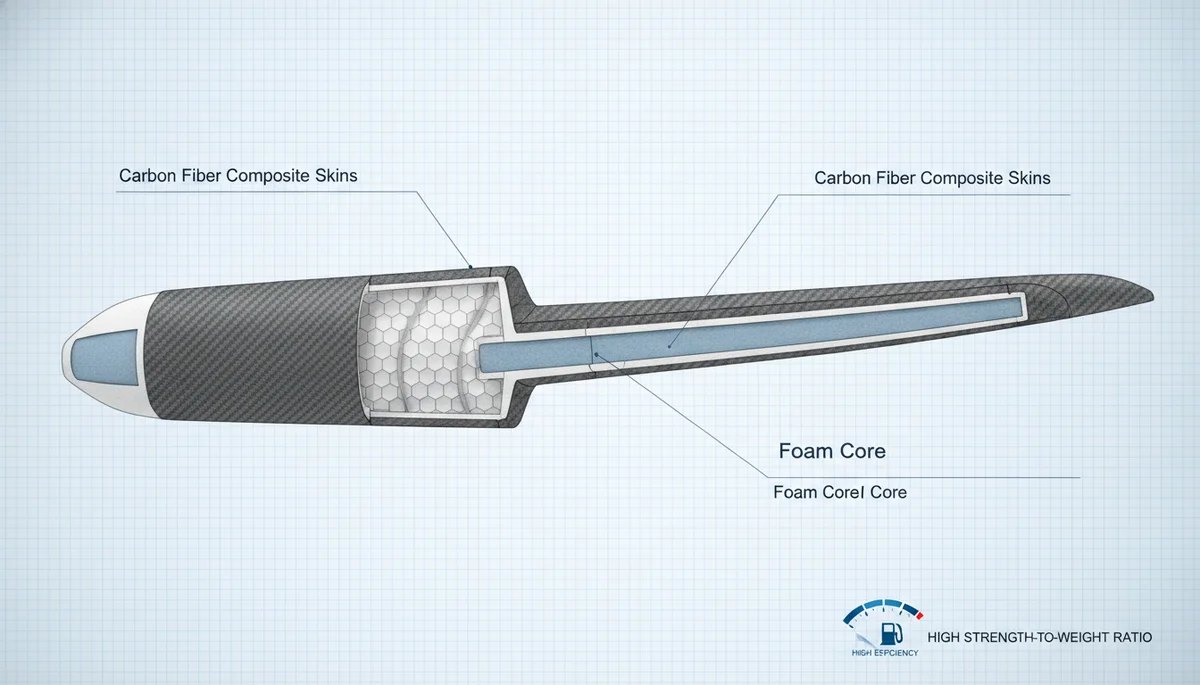
Composite sandwich panels deliver a stiffness-to-weight ratio up to 40 times greater than solid sheets of the same material. This single engineering principle is why they dominate structural applications.
Superior Flatness and Strength
The structural logic of a sandwich panel is straightforward: two thin, high-modulus face sheets are separated by a thicker, lightweight core. This geometry places the strongest materials at the outermost fibers where bending stresses are highest, while the core handles shear transfer and stabilizes the skins against buckling. The result is a panel that resists deflection far better than a solid sheet of equivalent mass.
Flatness is a direct byproduct of this rigidity. When a panel resists bending under its own weight or applied loads, the surface remains uniform. This matters intensely in applications like commercial building facades, refrigerated truck bodies, and marine vessel interiors, where even minor warping creates visible defects, seal failures, or assembly headaches down the line.
Achieving consistent flatness at production scale is where manufacturing discipline separates reliable suppliers from problematic ones. Uneven resin distribution, inadequate curing, or trapped air pockets during lamination all create internal stresses that cause panels to warp after installation. Our production line maintains daily output exceeding 1,700 square meters while holding dimensional tolerances tight, because we have learned through 15 years of production that volume means nothing if the panels do not lay flat on the job site.
The relationship between core density and panel stiffness is not linear. Doubling core thickness can increase flexural rigidity by a factor of four or more, depending on the facing material. This is why engineers often specify thicker, lower-density cores rather than heavier, thinner alternatives. A PET foam core at 100 kg/m³ with GRP facings can outperform a denser PU core at half the thickness in bending tests, while weighing less overall.
- Bending Stiffness: Governed by facing thickness, facing modulus, and core depth rather than total panel weight.
- Shear Transfer: The core must have sufficient shear modulus to prevent the two face sheets from sliding independently under load.
- Compression Stability: Face sheets under compressive stress require core support to prevent local buckling or wrinkling failures.
Delamination remains the most critical failure mode to monitor. When the bond between face sheet and core degrades, the panel loses its ability to function as a unified structure. Stiffness drops precipitously. In our experience testing panels returned from the field, the root cause is almost always inadequate surface preparation before bonding, not the adhesive chemistry itself. This is why we invest heavily in controlling the lamination environment and surface treatment processes.
Thermal Stability Advantages
Composite panels serve dual structural and insulating roles in most applications. The core material functions as a thermal break, dramatically reducing heat transfer through the panel cross-section. Foam cores such as XPS, PET, PU, and PVC trap gas within closed-cell structures, achieving thermal conductivity values typically between 0.020 and 0.035 W/(m·K) depending on the specific foam grade and density.
Thermal stability in this context means more than just insulation value. It refers to how the panel behaves under temperature cycling and sustained exposure to extreme heat or cold. A panel installed on a refrigerated truck body, for example, may face interior temperatures of -20°C while the exterior skin bakes at 50°C in direct sunlight. That thermal gradient generates differential expansion between the inner and outer skins, which imposes shear stress on the core and the adhesive bond lines.
Not all core materials handle this stress equally. PET foam maintains consistent mechanical properties across a broad temperature range and offers excellent long-term creep resistance, making it suitable for applications where thermal cycling is constant. PU foam provides superior initial insulation values but can experience dimensional drift at sustained high temperatures if not properly formulated. XPS offers good moisture resistance and stable thermal performance, though it has upper temperature limits that must be respected during both processing and service life.
Honeycomb cores, particularly PP honeycomb, present a different thermal profile. Their open structure provides less inherent insulation than closed-cell foams, but they excel in applications where thermal performance is handled by separate insulation layers and the primary requirement is maximum shear strength at minimum weight. Some manufacturers combine materials, using foam-filled honeycomb to capture both structural and insulating properties in a single core.
For buyers evaluating thermal performance, the relevant metric is the overall U-value of the complete panel assembly, not the core material alone. Facing material, panel thickness, joint design, and thermal bridging at connection points all influence real-world performance. We provide thermal modeling data for specific panel configurations rather than relying on generic core material specifications, because the assembled panel behavior is what determines whether a refrigerated truck holds temperature or a building envelope meets energy code requirements.
How to Choose Panel Cores
Core selection is the single most consequential engineering decision in sandwich panel design. The wrong core material will compromise structural integrity, thermal performance, and project economics, regardless of how advanced the outer skins are.
Matching Core to Application
The core material in a sandwich panel functions as the structural spine. It transfers shear loads between the outer face sheets, stabilizes the skins against buckling, and dictates the panel’s overall stiffness-to-weight ratio. Selecting the wrong core for a given application is not merely an efficiency loss. It is a primary driver of premature delamination, core crushing, and catastrophic stiffness degradation under load. The decision matrix must begin with the end-use environment and work backward to the material specification.
For structural applications demanding high compressive strength and shear rigidity, such as truck body panels, marine vessel bulkheads, and heavy-duty flooring, honeycomb cores are generally superior. PP honeycomb cores, in particular, have become the preferred solution in logistics equipment and transportation due to their balanced strength-to-weight ratio, inherent water resistance, and cost efficiency.
When composited with fiberglass face sheets, PP honeycomb delivers a rigid, lightweight structure that withstands repeated dynamic loading without permanent deformation. Our production line routinely runs PP honeycomb cores for refrigerated truck and dry freight truck bodies where the combination of impact resistance, moisture immunity, and structural longevity is non-negotiable.
For applications where thermal insulation is the dominant requirement (refrigerated transport, building envelopes, mobile housing), closed-cell foam cores are the rational choice. Each foam chemistry carries distinct advantages that must be matched to the operating conditions:
- XPS (Extruded Polystyrene): Low cost, good moisture resistance, adequate for general construction and mobile homes where extreme structural loads are not expected.
- PET Foam: Excellent dimensional stability, recyclable, and widely specified in European markets for RV walls and roofing applications where environmental compliance is tracked.
- PU (Polyurethane): Superior thermal insulation values, making it the standard core for refrigerated truck bodies where maintaining internal temperature is the primary functional requirement.
- PVC Foam: High strength-to-weight ratio with good fire resistance, commonly used in marine applications where both structural performance and flame spread ratings are critical.
- PMI Foam: Premium mechanical properties at minimal weight, reserved for aerospace, aviation, and high-performance applications where cost is secondary to performance.
The cost-performance trade-off is a persistent tension in core selection. Honeycomb cores generally outperform foam cores in specific stiffness and compressive strength, but they come at a higher raw material and processing cost. For large-volume B2B orders, such as outfitting a fleet of 200 refrigerated trailers, the unit price delta between a PU foam core and a PP honeycomb core compounds rapidly.
The engineering question becomes: does the application demand the extra structural margin, or does the insulation performance of the foam core deliver greater total value? In our experience working with truck manufacturers across Europe and Southeast Asia, the answer is almost always application-specific. Refrigerated trucks prioritize PU or XPS foam for thermal performance. Dry freight and logistics trucks benefit more from PP honeycomb for its crush resistance under repeated cargo loading cycles.
Mismatching the core to the application has real financial consequences that extend far beyond the initial material cost. A panel that delaminates in the field generates warranty claims, replacement logistics, installation labor, and reputational damage that can total 5 to 10 times the original panel price.
This is why our engineering team conducts experimental testing against specific data standards before finalizing any custom panel specification: we are verifying that the core-to-skin bond line integrity holds under simulated service loads, not just theoretical calculations.
Environmental Load Considerations
Environmental loads are the silent killers of composite panel systems. While engineers often focus on static mechanical loads (point loads, distributed loads, wind pressure), the environmental stressors of temperature cycling, moisture ingress, UV exposure, and chemical contact are responsible for the majority of in-service degradation. Core selection must account for the full spectrum of environmental loads the panel will experience over its intended service life, not just the nominal operating conditions.
Thermal expansion mismatch between dissimilar materials is one of the most underappreciated failure mechanisms in sandwich panels. When a panel combines FRP face sheets with a thermoplastic core (such as PET or PP), the two materials have different coefficients of thermal expansion. In environments with wide temperature swings, such as truck bodies operating across climatic zones or exterior wall cladding in continental climates, this differential expansion induces cyclic shear stress at the bond line.
Over thousands of thermal cycles, this stress can degrade the adhesive bond and initiate delamination that is invisible from the exterior until the panel loses structural stiffness. Our engineers address this by carefully matching the thermal expansion characteristics of the skin and core materials, selecting adhesive systems with sufficient elongation to accommodate differential movement, and in critical applications, specifying core materials with thermal expansion profiles that closely mirror the face sheets.
Moisture ingress is the second dominant environmental threat, particularly for marine, outdoor, and cold-chain applications.
Not all cores handle water exposure equally. Open-cell honeycomb structures, such as aluminum honeycomb, can trap moisture within the cells if the edge seals or skin bonds are compromised, leading to hidden corrosion or freeze-thaw damage in cold climates. Closed-cell foam cores (XPS, PET, PU, PVC) are inherently resistant to water absorption, making them the safer specification for any application where the panel will be exposed to rain, humidity, or washdown cycles.
PP honeycomb occupies a middle ground: the polypropylene itself is waterproof and chemically inert, but the cellular structure can hold water if the panel edges are not properly sealed during manufacturing. This is a processing quality issue, not a material limitation, and it is precisely why panel edge sealing and facing material selection matter as much as the core choice itself.
Chemical exposure adds another layer of complexity. Panels used in refrigerated trucks carrying food products must withstand frequent cleaning with aggressive sanitizing agents. Agricultural equipment panels may be exposed to fertilizers, fuels, and hydraulic fluids. Marine panels face salt spray and marine-grade cleaning compounds. The chemical resistance profile of the core material, and equally important the adhesive system bonding the core to the skins, must be evaluated against the specific chemical environment.
PP honeycomb and PVC foam both offer excellent chemical resistance across a broad range of industrial chemicals. PET foam performs well in most environments but can be susceptible to strong alkaline solutions. In our facility, we routinely test chemical compatibility as part of the custom specification process for clients in the agricultural and food transport sectors, because chemical degradation of the core is an insidious failure mode that rarely shows up in standard mechanical testing.
The practical approach is to build an environmental load profile for the specific project before specifying the core material. This profile should document the expected temperature range, humidity exposure, UV intensity, chemical contact, and mechanical loading cycles over the panel’s intended service life.
With that profile in hand, the core selection becomes a rational filtering exercise rather than a guessing game. Panels that offer long-term reliability across all these environmental vectors consistently deliver better total cost of ownership, even when their initial unit price is marginally higher than the cheapest available alternative.
Sourcing Composite Panels from Manufacturers
Sourcing composite panels directly from an OEM manufacturer eliminates intermediary markups and gives buyers engineering-level control over specs, tolerances, and quality consistency across large orders.
Direct Factory Sourcing Benefits
Procurement teams often default to local distributors for convenience, but when projects scale to hundreds or thousands of square meters, the cost and quality advantages of direct factory sourcing become difficult to ignore. Buying direct from a manufacturer with in-house production capabilities removes distributor margins, which typically add 15% to 30% to the final panel cost. For bulk orders of GRP/FRP sandwich panels or aluminum composite panels, those savings compound quickly.
Beyond price, direct sourcing solves a persistent supply chain problem: communication latency. When a distributor sits between the buyer and the factory, technical questions about core density, facing thickness, or adhesive systems get filtered, delayed, or lost. Dealing directly with the manufacturer means engineers on both sides can align on specifications without a middleman interpreting, or misinterpreting, critical tolerances.
Production transparency is another advantage that distributors simply cannot offer. A manufacturer operating its own advanced composite panel production line can provide real-time updates on order progress, batch-level quality control data, and raw material traceability. This is particularly important when panels are destined for structurally demanding applications like refrigerated truck bodies, marine vessels, or RV construction, where delamination or bond failure in the field is unacceptable.
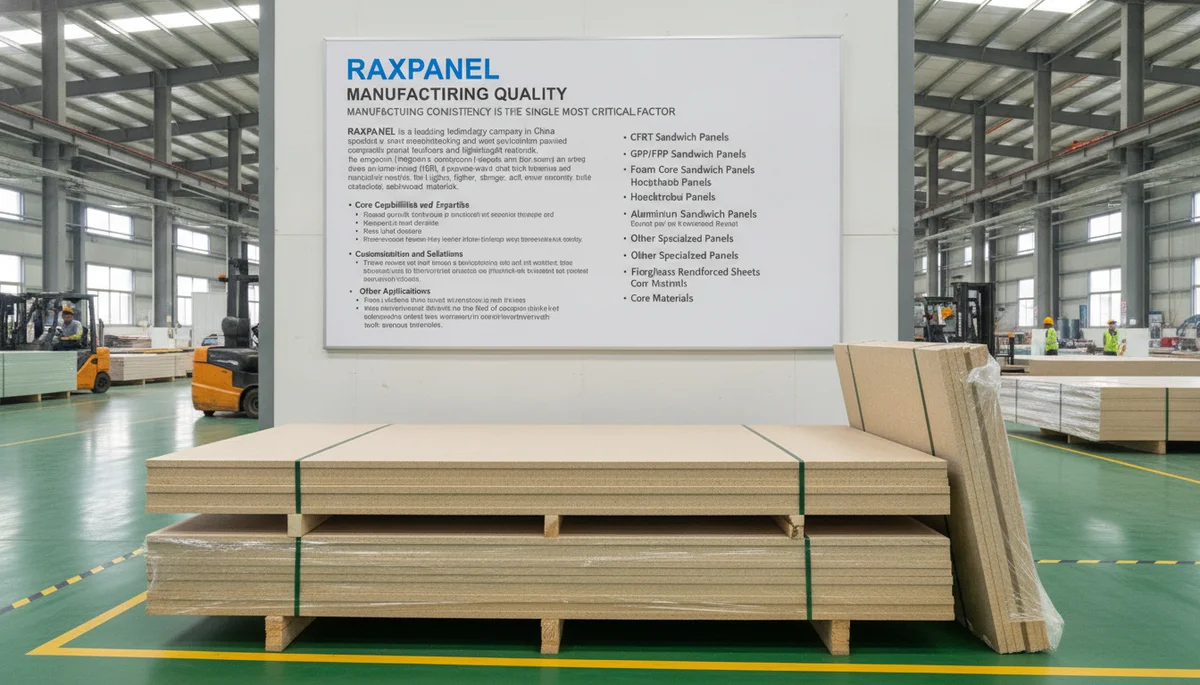
Scale matters. Factories with high daily output, in our case exceeding 1,700 square meters per day, maintain a level of process stability that smaller workshops cannot match. Continuous lamination lines run at controlled temperatures and pressures, ensuring uniform resin impregnation and consistent curing across every panel.
This directly addresses the structural integrity challenges that arise when production variables drift between batches. We have seen this firsthand: customers who previously sourced from small-scale workshops reported inconsistent panel thickness and bonding defects that disappeared once they shifted to a continuous production environment.
- Cost Efficiency: Eliminating intermediary distribution layers reduces per-panel costs by 15–30%, with greater savings on high-volume orders.
- Technical Communication: Direct access to factory engineers ensures precise alignment on core materials (XPS, PET, PU, PVC, honeycomb), facing options, and mechanical performance targets.
- Quality Traceability: OEM facilities track raw material batches and provide QC documentation that distributors typically cannot supply.
- Customization Capability: Factories with in-house R&D teams can engineer custom panel configurations, combining specific skins and cores, without the lead-time penalties of third-party coordination.
- Production Scalability: High-capacity continuous lamination lines deliver consistent quality across large orders, minimizing batch-to-batch variation.
Evaluating Manufacturer Warranties
A warranty is only as credible as the manufacturer standing behind it. In the composite panel industry, warranties typically range from 5 to 15 years, but the duration alone tells you very little. What matters is what the warranty actually covers, how claims are processed, and whether the manufacturer has the infrastructure to honor commitments across international borders.
Buyers should scrutinize warranty language for exclusions. Many warranties cover manufacturing defects but exclude failures caused by improper installation, environmental exposure beyond specified limits, or mechanical damage. For foam core and honeycomb sandwich panels, the most critical coverage area is delamination: the separation of facing skins from the core material.
This is the predominant failure mode in composite structures, and it often stems from inadequate adhesive bonding or poor surface preparation during manufacturing. If a warranty does not explicitly address delamination under normal service conditions, that is a significant red flag.
Request detailed documentation before committing. A reputable manufacturer should provide test reports for mechanical properties (flexural strength, shear modulus, peel strength) along with environmental aging data. These reports demonstrate that the panels have been validated against recognized standards, not just produced to a generic specification. Manufacturers with over a decade of production history are generally better positioned to offer meaningful long-term warranties because their track record provides empirical evidence of product durability.
For international buyers, warranty enforcement is a practical concern. If a defect is discovered on a shipment delivered to Europe or North America, the logistics of returning panels or filing a claim across time zones and legal jurisdictions can be complex. This is where the manufacturer’s service infrastructure becomes critical.
A factory with a dedicated international sales team offering multilingual support and 24-hour response capability can manage claims efficiently, reducing downtime for the buyer. Our own service model was built around this reality: maintaining one-to-one communication channels throughout the sales, production, and post-delivery phases specifically to prevent warranty issues from becoming drawn-out disputes.
- Coverage Scope: Verify that the warranty explicitly covers delamination and bonding failures, not just cosmetic defects or manufacturing anomalies visible at delivery.
- Test Data Availability: Require flexural, shear, and peel strength test reports conducted against recognized standards before approving any supplier.
- Claims Process: Understand the procedure for filing defects, including who inspects, what documentation is required, and what the resolution timeline looks like.
- International Support: Confirm the manufacturer has multilingual staff and structured post-sale service for your region, not just a generic email address.
- Production Longevity: Favor manufacturers with 10+ years of operational history, as warranty promises from newly established factories carry inherent risk.
Conclusion
Selecting the right composite panel comes down to matching core material to structural demands and environmental conditions. Get this wrong, and delamination failures eat your margin within two years.
- Don’t default to foam cores for fire-rated assemblies: aluminum honeycomb handles thermal loads better and keeps your projects compliant.
- Skipping adhesive bond testing during procurement saves nothing upfront. It guarantees warranty claims and replacement costs later.
- Request documentation on continuous lamination quality control before committing to any supplier. Our engineering team at Rax Panel reviews project specs daily. With 15 years of manufacturing experience across 50 countries, we answer early-stage design questions at zero cost or obligation.
Frequently Asked Questions
What is the difference between MCM and ACM?
ACM specifically refers to panels with aluminum face sheets, whereas MCM is a broader term that includes other metal skins like zinc, copper, stainless steel, and titanium.
What is the difference between PE and FR cores?
Standard PE cores are lightweight, flexible, and highly combustible. FR (fire-resistant) cores are modified with halogen-free flame retardants to resist ignition and prevent fire spread.
What are A2 composite panel cores made of?
Premium A2 cores are engineered to be non-combustible, consisting of 90% inorganic minerals and only 10% recyclable polyethylene acting as a binder.
Where are B1 fireproof core panels typically used?
B1 panels are widely specified for mid-rise structures, shopping malls, and educational facilities where enhanced fire safety is required without compromising flexibility.
What metals are used in MCM panel skins?
Metal Composite Material (MCM) panels can feature natural metal skins such as aluminum, zinc, copper, stainless steel, and titanium.