

Industrial noise control requires a strict engineering distinction between sound absorption and sound transmission loss: Acoustic Panels dissipate internal reverberation (NRC 0.85–0.95), Noise Barriers block line-of-sight propagation (Insertion Loss 12–22 dBA), and Acoustic Enclosure Walls provide total boundary containment (STC 42–52 dB / Rw 40–50 dB). Selecting the correct acoustic architecture is mandatory to achieve OSHA 1910.95 compliance (≤ 85 dBA 8-hour TWA) under ASTM E90 and ISO 10140-2 laboratory testing standards.
Across our 15+ years of engineering acoustic sandwich panels and industrial noise enclosures at RaxPanel, our technical team frequently encounters plant managers who misdiagnose their acoustic failure. A common mistake is installing absorptive wall baffles to silence a 105 dBA stamping press, only to find neighbor boundary noise remains unchanged because absorption panels do not stop sound transmission. In our acoustic chamber testing and turnkey plant retrofits, matching the correct acoustic mechanism to the machinery frequency spectrum is the only way to guarantee regulatory compliance without budget overruns.

Figure 1: Modular industrial acoustic panel system combining high-density rockwool absorption cores with sound-blocking composite barrier skins.
Sound Absorption vs. Sound Transmission Loss
A fundamental challenge in plant noise mitigation is understanding the logarithmic physics of acoustic energy. Sound pressure levels cannot be summed linearly: two identical 85 dBA machines operating side-by-side produce a cumulative sound pressure level of 88 dBA ($L_{p, ext{total}} = 10 \log_{10} \sum 10^{L_i/10}$), instantly pushing an otherwise compliant workstation into mandatory OSHA hearing conservation enforcement.
Furthermore, porous absorption materials cannot physically stop sound transmission through structural envelopes. Specifiers must differentiate between two distinct physical mechanisms:
Sound Absorption Physics
Dissipates incident sound wave kinetic energy into microscopic frictional heat inside open-cell fibers. Governed by ASTM C423 Noise Reduction Coefficient (NRC).
Sound Transmission Loss (STL)
Blocks acoustic energy from transmitting across a solid partition. Governed by the Mass Law ($TL \propto 20 \log(m \cdot f)$) and rated via ASTM E90 STC / ISO 717-1 Rw.
Barrier Insertion Loss (IL)
Measures actual decibel reduction at a specific receiver point when a solid barrier interrupts the direct line-of-sight sound ray path (governed by ISO 9613-2).
OSHA 1910.95 Compliance
Enforces an 85 dBA Action Level (mandatory hearing conservation) and a 90 dBA Permissible Exposure Limit (PEL) for industrial workforces.
Acoustic Panels for Reverberation and Echo
Industrial acoustic panels are porous absorber units designed to be surface-mounted or suspended as vertical baffles inside noisy manufacturing plants.

Figure 2: Micro-perforated acoustic sandwich panels engineered to trap high-frequency machinery noise and eliminate reverberant buildup.
1. Mechanism of Action: Porous Friction Damping
When sound waves strike an acoustic panel, air molecules oscillate within the tortuous interconnected pores of high-density mineral wool (120–150 kg/m³). Viscous drag converts the acoustic pressure wave into low-grade thermal energy. RaxPanel acoustic panels incorporate a micro-perforated aluminum facing (23% open area with an internal non-woven acoustic veil) that protects the core from industrial oils while allowing sound waves to enter unobstructed.
2. The Noise Reduction Coefficient (NRC 0.85 to 0.95)
Under ASTM C423 testing, an NRC of 0.90 means the panel absorbs 90% of incident sound energy at 250 Hz, 500 Hz, 1000 Hz, and 2000 Hz, reflecting only 10%. In large industrial machine halls, installing acoustic panels across 30% to 40% of the ceiling and upper wall surface reduces overall reverberant noise build-up by 4 to 8 dBA.
For cleanroom environments with strict acoustic requirements, consult our guide on cleanroom HVAC acoustic standards.
Noise Barriers for Line-of-Sight Shielding
Noise barriers are free-standing solid or semi-absorptive acoustic screens positioned directly between an outdoor or indoor noise source and nearby personnel or property boundaries.
A noise barrier works by forcing sound waves to bend (diffract) over its top edge and around its side flanks. In our field acoustic surveys, engineers frequently forget lateral edge diffraction: if a barrier is not wide enough, sound diffracts around the vertical ends, destroying the acoustic shadow zone.
To ensure true 12 to 22 dBA insertion loss in accordance with ISO 9613-2 engineering standards, barrier width must extend at least three to four times the source-to-barrier distance, or wrap around the equipment in an L-shaped or U-shaped configuration. Furthermore, because outdoor barrier walls present high wind resistance, RaxPanel barriers incorporate internal structural steel stiffeners engineered to withstand 140 km/h hurricane gusts without structural deflection.
A noise barrier works by forcing sound waves to bend (diffract) over its top edge. According to Maekawa’s barrier diffraction formula ($N = rac{2}{\lambda} \cdot \delta$), the attenuation (Insertion Loss) is directly proportional to the Fresnel number $N$. To achieve an effective 10 to 18 dBA reduction, the barrier must completely break the direct line-of-sight, extending at least 0.5 meters above the noise source height.
RaxPanel modular noise barriers combine an exterior solid aluminum or galvanized steel skin (to block transmission) with an interior perforated absorptive face (to prevent sound from reflecting back onto the machine). This dual-action design eliminates standing waves between parallel equipment rows.
Acoustic Enclosures for Heavy Equipment Noise
When heavy industrial machinery generates noise levels exceeding 100 dBA, neither wall panels nor partial barriers can achieve OSHA compliance. Full or semi-sealed Acoustic Enclosures fabricated from high-performance composite sandwich wall panels are required.

Figure 3: Heavy-duty acoustic sandwich wall panels featuring constrained-layer damping cores for high Sound Transmission Class (STC) ratings.
1. High Sound Transmission Class (STC 42 to 52 dB / Rw 40 to 50 dB) & Coincidence Dip Suppression
In single-layer monolithic walls, sound transmission loss suffers a severe drop at the critical coincidence frequency ($f_c$), where the bending wave velocity in the metal skin matches the speed of sound in air. At this frequency (typically 1200 Hz to 2500 Hz for sheet metal), the wall becomes acoustically transparent.
RaxPanel acoustic sandwich wall panels overcome the coincidence dip by employing asymmetrical skin metallurgy (e.g., a 0.8 mm outer steel skin paired with a 1.2 mm inner perforated aluminum skin) bonded across a visco-elastic damping septum. The differing bending stiffnesses decouple resonance modes, delivering flat, reliable transmission loss across all critical 1/3 octave bands from 125 Hz to 4000 Hz.
Under ASTM E90 and ISO 10140-2 laboratory tests, RaxPanel 50 mm to 100 mm acoustic sandwich wall panels achieve an STC of 45 dB to 52 dB. The construction combines heavy mass (dual 0.8 mm steel or 1.2 mm aluminum skins), a 5 kg/m² mass-loaded vinyl (MLV) septum, and a dense hydrophobic rockwool core.
2. Ventilation Silencers and Acoustic Access Doors
Operating machinery inside an enclosure generates significant heat. Complete industrial acoustic wall systems integrate tuned intake/exhaust acoustic splitters (silencer baffles) and high-STC double-gasket access doors. For critical door hardware specifications, see our acoustic seal cleanroom door guide.
Comparing Panels, Barriers, and Enclosure Walls
The following engineering decision matrix compares all three industrial noise control architectures:
| Acoustic Metric | Acoustic Wall Panels | Noise Barriers / Screens | Acoustic Enclosure Walls |
|---|---|---|---|
| Primary Physical Function | Sound Absorption (Echo Damping) | Line-of-Sight Diffraction Shielding | Complete Sound Transmission Loss |
| Governing Standard Rating | NRC 0.85–0.95 (ASTM C423) | Insertion Loss 12–22 dBA (ISO 9613-2) | STC 42–52 dB / Rw 40–50 dB (ASTM E90) |
| Typical Decibel Reduction | 3 to 8 dBA (Ambient space) | 8 to 15 dBA (In shadow zone) | 20 to 45 dBA (Total containment) |
| Best Source Noise Level | 80 to 90 dBA (Reverberant halls) | 85 to 98 dBA (Directional sources) | 95 to 125+ dBA (Extreme machinery) |
| Equipment Access Impact | Zero restriction (Wall mounted) | Minimal (Open top / perimeter) | Requires acoustic doors & hatches |
| Ventilation Integration | Not applicable | Natural open airflow | Mandatory forced air silencers |
| Installed Cost Level | Low ($60–$120 / m²) | Moderate ($150–$280 / m²) | High ($350–$650 / m² complete) |
Matching Noise Solutions to Industrial Machinery
Different industrial machines produce vastly different acoustic frequency spectra requiring tailored control strategies:
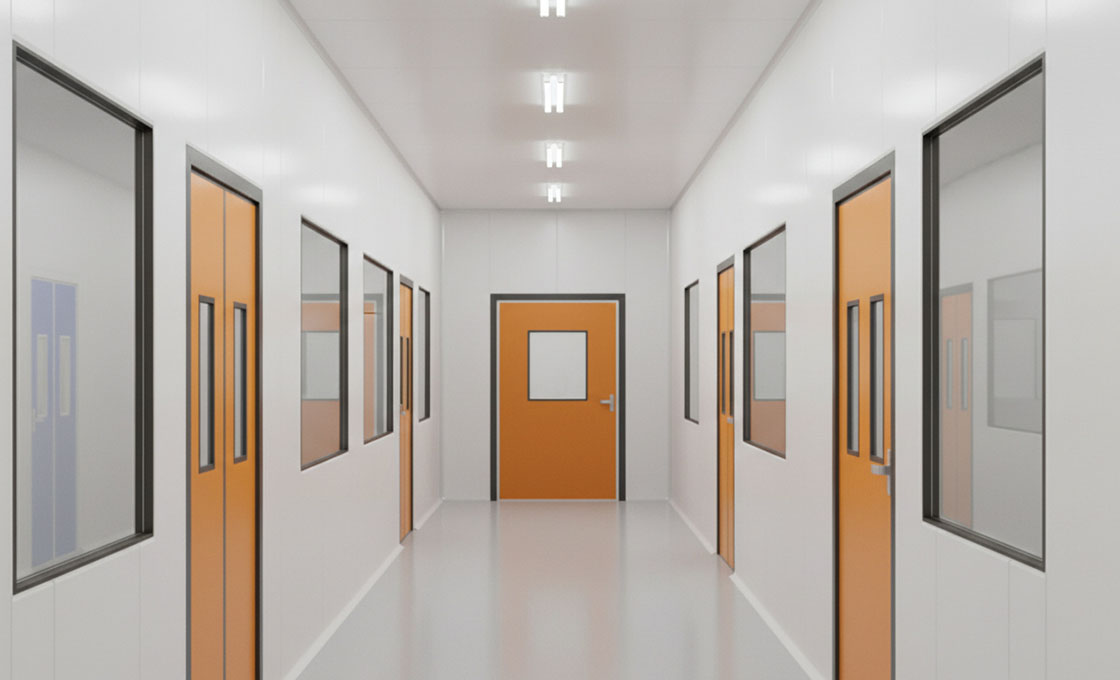
Figure 4: Turnkey industrial machinery acoustic partition wall delivering high transmission loss and localized operator protection.
1. Rotary Screw Air Compressors and Vacuum Pumps (92 to 102 dBA)
Dominated by high-frequency tonal whine (1000 Hz to 4000 Hz). Recommended Solution: Four-sided modular acoustic enclosure with forced ventilation silencers. Achieves an external noise level below 75 dBA at 1 meter.
2. Mechanical Stamping Presses and Metal Forging (105 to 118 dBA)
Generates high-energy low-frequency impact pulses (63 Hz to 250 Hz) and severe ground-borne vibration. Recommended Solution: Heavy double-skin acoustic enclosure walls (STC ≥ 50 dB) with isolated concrete foundation pads and internal NRC 0.95 absorption baffles to suppress internal pressure reverberation.
3. Rooftop HVAC Chillers and Cooling Towers (85 to 95 dBA at Property Line)
Generates low-frequency fan drone and water splashing. Recommended Solution: U-shaped outdoor acoustic barrier walls (3.5 to 5.0 meters high) with weather-resistant perforated composite panels, shielding neighboring residential property boundaries.
5-Step Engineering Sizing and Selection Protocol
Follow this 5-step engineering protocol when designing plant noise mitigation:
-
Step 1: Conduct 1/3 Octave Band Noise Survey
Measure the sound pressure level (Lp in dBA) and frequency spectrum across 1/3 octave bands (63 Hz to 8000 Hz) at the operator workstation and plant property boundary using an IEC 61672 Class 1 integrating sound level meter. High-precision spectral logging identifies narrow tonal peaks that drive worker fatigue.
-
Step 2: Calculate Required Decibel Attenuation ($\Delta L$)
Subtract target compliance limit (e.g., OSHA 85 dBA or boundary 55 dBA) from measured source noise. If $\Delta L \le 6 ext{ dBA}$, specify room absorption panels; if $\Delta L = 8 ext{–}15 ext{ dBA}$, specify line-of-sight barriers; if $\Delta L > 15 ext{ dBA}$, mandate a full enclosure.
-
Step 3: Evaluate Ventilation and Heat Rejection Needs
Calculate machinery heat dissipation (kW). Size acoustic intake/exhaust silencers to maintain airflow velocity below 5 m/s, preventing aerodynamic noise generation.
-
Step 4: Design Structural Wind & Seismic Bracing
For outdoor barrier walls, calculate wind overturning moments under ASTM E330 standards to size steel wide-flange (H-beam) support posts and concrete piers.
-
Step 5: Enforce Acoustic Seal Integrity (Acoustic Caulking)
Seal all panel perimeter joints, floor tracks, and conduit penetrations with non-hardening acoustic sealants to eliminate sound flanking paths.
1. The “Acoustic Short-Circuit” (Flanking Leaks): A 1% unsealed gap or uncaulked floor track around an STC 50 enclosure drops the effective overall performance down to STC 20, destroying 90% of the acoustic investment.
2. Mistaking Porous Panels for Sound Barriers: Hanging fiberglass or foam panels on an existing chain-link fence provides zero sound blocking. Panels only absorb reflections; dense mass is required to stop transmission.
3. Overlooking Structure-Borne Vibration: High STC enclosure walls cannot stop noise if the machine is bolted rigidly to the common floor slab. Always install elastomeric or spring vibration isolators under machine feet.
4. Ignoring Silencer Regenerated Noise: Sizing acoustic duct silencers with excessive airflow resistance creates turbulent air hiss that bypasses the enclosure walls. Maintain air velocity below 5 m/s.
5. Inadequate Barrier Height in Outdoor Arrays: Installing a barrier that just matches equipment height allows sound waves to diffract cleanly over the top. Always extend the barrier minimum 0.5 m above direct line-of-sight.
6. Rigid Mechanical Conduit and Duct Bridging: Hard-bolting heavy ventilation ductwork or electrical conduits directly through enclosure sandwich panels transmits machine vibration into the outer room structure. Always install elastomeric flexible canvas duct boots and rubber pipe penetration isolators.
For complete industrial and cleanroom partition engineering, explore RaxPanel’s high-performance engineered acoustic and cleanroom panel systems designed for demanding acoustic and environmental compliance.
Common Flanking Noise and Mitigation Traps
Frequently Asked Questions on Noise Control
What is the difference between NRC and STC ratings in industrial acoustics?
NRC (Noise Reduction Coefficient) measures how much acoustic energy a material absorbs within a space on a scale of 0.0 to 1.0 (with NRC 0.90 absorbing 90% of incident reverberant sound under ASTM C423 testing). STC (Sound Transmission Class) is a logarithmic decibel rating measuring how effectively a solid partition blocks sound transmission under ASTM E90 (where an STC 50 composite wall reduces transmitted sound power by 50 dB across speech and industrial frequencies).
Can acoustic panels alone solve an OSHA noise violation?
Only in specific reverberant rooms where machine noise is just 3 to 6 dBA above the OSHA 85 dBA threshold. If an operator stands directly next to a 100 dBA machine, acoustic wall panels cannot reduce direct sound exposure; a noise barrier or complete machine enclosure is required.
How thick should an industrial acoustic enclosure wall panel be?
Standard industrial enclosures utilize 50 mm (2″) to 100 mm (4″) thick composite sandwich panels featuring high-density mineral wool (120–150 kg/m³) and heavy metal skins. A 50 mm panel delivers STC 42–45 dB, while a 100 mm dual-core panel delivers STC 50–52 dB.
How do outdoor noise barriers withstand high wind loads?
Industrial outdoor barrier panels are structural sandwich composites engineered with internal stiffeners and slide-in mounting flanges. They are mounted between structural steel H-beams (wide flange columns) anchored into deep concrete pier foundations engineered to withstand 150+ km/h wind gusts.
Do acoustic enclosures cause industrial machinery to overheat?
Not when properly engineered. Industrial enclosures integrate forced-air ventilation systems with tuned acoustic silencer baffles that allow high CFM airflow while trapping machine noise inside.