

Reducing overall vehicle weight without compromising thermal efficiency is the primary engineering challenge for modern RV production. You cannot simply thin the walls or switch to cheaper foams to hit your targets, because that approach usually fails the moment the chassis hits a rough highway. At RaxPanel, we utilize high-speed continuous line manufacturing to maintain the tight thickness tolerances required for road-rated assemblies.
Selecting the right insulated metal panel manufacturer means looking past the spec sheet to see how a supplier handles vibration fatigue and moisture absorption. We compare the structural rigidity of aluminum honeycomb cores against traditional foam fills to show where actual weight savings exist. You will learn why batch consistency matters more than unit price when you are trying to avoid a warranty disaster.
IMPs vs. Traditional RV Panels: Strength and Weight Compared
IMPs fundamentally alter the engineering equation for RV construction, replacing heavy, inconsistent wood framing with a composite structural skin that maximizes stiffness while minimizing mass.
For OEMs and fleet managers, the shift from traditional wood-framed assemblies to Insulated Metal Panels (IMPs) is not merely a material substitution; it is a strategic move to optimize the vehicle’s Gross Vehicle Weight Rating (GVWR). The inherent inefficiency in traditional RV walls lies in the reliance on wood studs for structural support. While wood provides sufficient compressive strength, it adds significant mass without contributing to the wall’s sheer or torsional stability. By moving to composite construction, the structural load is transferred to the facings and core, allowing for the drastic reduction—or complete elimination—of internal wood framing. This shift allows manufacturers to allocate weight budget to premium amenities or battery systems without sacrificing durability.
Density Comparisons: Aluminum Skins vs Wood Framing
When evaluating areal density, the contrast between aluminum or composite facings and wood framing is stark. Wood is a hygroscopic material; its density fluctuates based on moisture content, leading to unpredictable weight variances in the final build. In contrast, metallic and GRP (Glass Reinforced Plastic) skins offer a consistent density profile. The critical advantage of IMPs, however, is the removal of the “dead weight” associated with stud spacing. In a traditional wall, studs occupy surface area but offer no thermal barrier, effectively creating heavy thermal bridges. We have observed that replacing Lauan or plywood studs with a continuous foam core system—bonded between lightweight aluminum or high-modulus GRP facings—significantly lowers the overall panel density while distributing loads more evenly across the wall’s surface area.
- Material Consistency: Unlike natural wood fibers which vary in density, aluminum and FRP facings provide uniform weight distribution, crucial for balancing axle loads in large RVs.
- Space Efficiency: Traditional wood framing often requires 2×2 or 2×4 inch studs, whereas structural foam cores achieve superior performance with a fraction of the material volume.
- Water Impact: Wood absorbs water, increasing its density over time and leading to rot. IMP cores (such as XPS or PET) are closed-cell and resist moisture absorption, maintaining their designed weight for the vehicle’s lifespan.
Thermal Performance: Foam Cores vs Fiberglass Insulation
Thermal efficiency in mobile environments is compromised less by the insulation material itself and more by the continuity of the thermal envelope. Traditional RV walls typically utilize fiberglass batting between wood studs. While fiberglass has moderate insulative properties, its performance is degraded by two factors: compression within the stud cavity and thermal bridging through the wood studs themselves. Wood conducts heat approximately 3 to 4 times faster than the foam insulation materials used in IMPs. This creates a “thermal short circuit” that effectively bypasses the insulation layer.
In our engineering analysis of composite panels, the use of continuous foam cores—such as PU (Polyurethane), PET, or XPS—eliminates these gaps entirely. The core acts as a thermal break that spans the entire wall surface, preventing heat transfer paths. Furthermore, the closed-cell structure of these foams inhibits convective air loops within the insulation, a common issue in loosely packed fiberglass batts. For manufacturers targeting four-season RV certifications, the switch to a foam core system is often necessary to prevent condensation formation on the interior skins, as the interior surface temperature remains much closer to the ambient interior temperature.
Structural Rigidity: Bending Strength Metrics
The superior rigidity of IMPs is derived from composite action, a mechanical principle where dissimilar materials bond together to perform better than the sum of their parts. In a traditional stud wall, the skin (filon or siding) is merely a cladding; it possesses little structural value and relies entirely on the wood studs to resist bending and shear. This creates a “stress-skin” system that is prone to racking and warping under torsional loads, such as when the RV is traversing uneven terrain.
Conversely, an IMP behaves as a monolithic I-beam. The stiff facings (GRP, CFRT, or Aluminum) resist the bending moments (tension and compression), while the lightweight foam core resists the shear forces and keeps the facings separated. This separation of the high-strength facings dramatically increases the panel’s Moment of Inertia. Our testing on CFRT (Continuous Fiber Reinforced Thermoplastic) sandwich panels demonstrates that they provide a much higher stiffness-to-weight ratio compared to conventional wood assemblies. This structural integrity allows for larger window and door openings without additional header reinforcement, giving designers greater freedom without compromising the wall’s load-bearing capacity.
- Shear Resistance: The foam core effectively transfers shear loads between the facings, preventing the “oil-canning” effect often seen in thin metal skins attached to flexible wood frames.
- Impact Resistance: GRP and CFRT facings offer high tensile strength, meaning the wall can absorb localized impacts from road debris without the permanent denting or cracking typical of thin aluminum or fiberglass skins.
- Deflection Control: The high modulus of elasticity in composite facings ensures the wall remains flat under load, preventing the visual waviness often found in traditional hung-wall systems over time.
| Feature | IMPs | Traditional RV Panels | Advantage |
|---|---|---|---|
| Weight (kg/m²) | 8–14 kg/m² | 18–32 kg/m² | Up to 55% lighter with IMPs |
| Core Material Options | XPS, PET, PU, PVC, PMI, EPP, Honeycomb | Lauan, EPS, minimal foam | Wider core selection enables optimized strength-to-weight ratios |
| Tensile Strength | 150–350 MPa (GRP/CFRT facings) | 40–90 MPa (wood/lauan-based) | 2–4× higher structural strength with composite facings |
| Thermal Insulation (R-value) | R-5 to R-12 per inch | R-2 to R-4 per inch | Superior insulation reduces HVAC load and energy costs |
| Water & Moisture Resistance | Fully waterproof; no rot or delamination | Absorbs moisture; prone to rot and mold | Longer service life and lower maintenance in humid environments |
How IMPs Adapt to Any RV Floorplan or Design
IMPs are engineered for dimensional flexibility and geometric precision, enabling manufacturers to match any RV layout without retooling costs or assembly-line disruption.
Modular Panel Dimensions for Custom Floorplans
RV floorplans vary dramatically across Class A, Class C, and travel trailer segments. Each layout demands panels sized to fit specific bay widths, door openings, window cutouts, and roof rake angles. Insulated metal panels address this through modular dimensioning — panels are manufactured to exact length and width specifications rather than forcing the design to fit a fixed panel size.
The standard panel thickness range for RV wall applications spans 25mm to 50mm, with common configurations at 30mm, 35mm, and 40mm. Lengths can be produced up to 13 meters in a single continuous run on modern continuous production lines, minimizing field joints. Widths are typically standardized at 1,000mm or 1,200mm effective coverage, though custom widths are achievable without retooling the core extrusion or skin roll-forming stations.
- Panel thickness tolerance: ±0.5mm across the full production run, ensuring consistent fitment across mixed-dimension orders.
- Length customization: Cut-to-length capability allows panels to match individual bay dimensions, eliminating on-site trimming.
- Width options: Standard 1,000mm and 1,200mm effective widths; narrower strips for tight spaces are produced by slitting wider panels post-cure.
- Batch consistency: Panels ordered in a single production run maintain uniform color, surface texture, and core density, critical for visual alignment across large RV sidewalls.
For RV producers managing multiple floorplan SKUs from the same assembly line, the ability to order panels in varied dimensions within a single purchase order — without triggering minimum run penalties or extended lead times — is a significant operational advantage. Continuous manufacturing lines can switch between thicknesses and widths within a single shift, allowing a producer to fulfill an order containing 20 different panel sizes without stopping the line for retooling.
Precision CNC Cutting for Complex Geometries
RV exteriors are not composed of simple rectangles. Curved sidewalls, angled front caps, arched window openings, and tapered rear sections require panels with precise cutouts and shaped edges. Modern insulated metal panels are compatible with CNC routing and waterjet cutting systems, enabling complex geometries to be produced directly from the panel sheet without secondary fabrication steps.
CNC cutting of IMPs is performed using specialized router bits designed for sandwich structures — typically diamond-coated or carbide-tipped end mills that cut through the metal skin and core material in a single pass without delaminating the layers. Waterjet cutting is an alternative for panels requiring extremely tight tolerances or complex contour profiles, as the high-pressure abrasive stream cuts through both metal skins and the insulating core without generating heat that could affect the foam structure.
- Cutout precision: CNC routers achieve tolerances of ±0.3mm for window, door, and vent openings, ensuring factory-fitted hardware without field modification.
- Curve capability: Panels can be routed to match convex and concave curvature profiles used in modern RV body styling, with minimum bend radii dependent on panel thickness and core type.
- Edge finishing: Cut edges are clean and burr-free with proper tooling, eliminating the need for secondary edge deburring or sealing in most applications.
- Multi-panel nesting: CAD-driven nesting software arranges multiple panel cutouts on a single sheet to minimize scrap, a critical factor when producing high-mix, low-volume floorplan variants.
The integration of CNC cutting into the IMP supply chain means that an RV manufacturer can submit a digital floorplan file — typically in DXF or DWG format — and receive panels pre-cut to exact geometry. This eliminates the traditional workflow where panels were cut to rough dimensions and then trimmed on-site, a process that introduced variability, increased labor cost, and compromised sealant integrity at cut edges.
Surface Finish Customization for Exterior Design
The exterior appearance of an RV is a primary differentiator in a competitive market. Insulated metal panels support a wide range of surface finish options that allow manufacturers to achieve distinct brand identities without switching materials or adding secondary cladding layers. The outer metal skin — typically aluminum or steel — is coated with a paint system that is cured in the production line, integrating the finish directly into the panel manufacturing process.
The two primary coating systems used on RV-grade IMPs are PVDF (polyvinylidene fluoride) and high-quality polyester. PVDF coatings offer superior UV resistance and color retention, typically maintaining gloss and chroma stability for 20–30 years under continuous solar exposure. Polyester coatings provide a cost-effective alternative with good durability for regional markets with moderate UV exposure, though they typically carry a shorter warranted lifespan. Both systems are available in a full spectrum of RAL and custom color matches.
- PVDF coatings: Available in standard and metallic finishes; superior chalk and fade resistance; suitable for high-UV markets and premium RV segments.
- Polyester coatings: Cost-competitive; available in matte, satin, and gloss sheens; adequate for markets with moderate climate exposure.
- Custom color matching: Suppliers can match brand-specific or model-year color palettes using RAL references or physical color samples, with a typical color consistency tolerance of ΔE < 1.5 between production batches.
- Textured finishes: Embossed or stucco-patterned skin textures are available to reduce visible surface imperfections and provide a premium tactile appearance.
- Graffiti-resistant and anti-bacterial options: Specialized topcoat systems are available for commercial or shared-use RV applications where surface hygiene and vandalism resistance are priorities.
Surface finish selection also interacts with thermal performance. Lighter-colored panels reflect more solar radiation, reducing heat gain through the panel assembly — a meaningful factor for RVs parked in direct sunlight. Darker finishes absorb more solar energy, which can increase interior cooling loads in warm climates. For producers offering the same floorplan in multiple color options across different regions, this thermal differential should be factored into the HVAC sizing for each variant.
The ability to apply the exterior finish during panel manufacturing — rather than painting assembled RV bodies in a separate finishing booth — reduces production complexity, eliminates the need for paint booth infrastructure, and ensures a uniform, factory-controlled coating quality that is difficult to replicate with on-site painting. This integrated finish approach is one of the key reasons IMPs support rapid assembly-line throughput while maintaining consistent aesthetic quality across every unit produced.
How IMP Cores Maintain R-Value on the Road
The Mechanics of Thermal Resistance in Transit
Maintaining listed R-value is not a static condition; it is a dynamic battle against road vibration, thermal expansion, and delamination risks that turn insulation gaps into thermal bridges.
For B2B buyers, the critical distinction lies in understanding that laboratory R-values are measured in static conditions. On the road, an insulated metal panel (IMP) is subjected to a chaotic environment involving constant vibration from the chassis and rapid temperature fluctuations. If the core material compresses under load or the adhesive bond to the metal skin weakens due to thermal expansion mismatches, microscopic gaps form. These gaps allow convection currents within the panel, actively degrading the thermal resistance. Therefore, the “maintained” R-value is strictly dependent on the dimensional stability of the foam and the integrity of the lamination process.
Comparative Core Material Performance
Not all foam cores react identically under the stress of transit. Selecting the correct core material is the primary decision point for ensuring long-term thermal efficiency. The table below contrasts the thermal resistance and stability characteristics of the four primary core types used in RV and transport applications.
| Core Material | R-Value (Per Inch) | Thermal Stability Note |
|---|---|---|
| Polyisocyanurate (PIR) | 7.2 – 8.0 | Highest thermal efficiency; superior fire resistance and dimensional stability compared to PUR. |
| Polyurethane (PUR) | 5.0 – 7.2 | Standard industry grade; effective insulation but prone to higher thermal drift over long periods. |
| Extruded Polystyrene (XPS) | ~4.0 – 4.5 | Excellent moisture resistance and compressive strength; minimal R-value loss over time. |
| Polyethylene Terephthalate (PET) | ~3.5 – 4.0 | High structural rigidity and eco-friendly; maintains consistent R-value with exceptional thermal recovery. |
Resisting Temperature Extremes: -30°C to +70°C
RV panels face extreme thermal cycling, often shifting rapidly from sub-zero freezing at night to scorching heat in direct sunlight. This swing places immense stress on the foam’s cell structure.
- PIR and PUR Cores: These closed-cell foams utilize blowing agents with low thermal conductivity. However, at temperature extremes near -30°C, the foam can become brittle, increasing the risk of micro-fractures during chassis flexing. Conversely, at +70°C, thermal expansion can cause the foam to pull away from the facings if the adhesive system is not thermally compatible. High-quality PIR formulations generally exhibit lower linear expansion coefficients, maintaining the bond line integrity better than standard PUR in these swings.
- XPS and PET Cores: These thermoplastics offer distinct advantages in thermal recovery. XPS has a high melting point and retains its insulating gas well, preventing “thermal drift” (the gradual loss of R-value as gases escape and air enters). PET foam is particularly resistant against thermal fatigue; it does not undergo the same chemical curing shifts as polyurethanes, ensuring that the R-value remains consistent regardless of how many times the panel heats up and cools down.
Preventing Delamination and Gas Loss
The primary threat to R-value on the road is not just the foam itself, but the interface between the foam and the metal or composite skins. Road vibration acts as a constant fatigue test on the lamination.
If the core material absorbs moisture (hydroscopic tendencies), any water trapped inside the panel freezes at sub-zero temperatures. Water expands when frozen, creating internal pressure that fractures the cell walls and drastically lowers thermal resistance (since ice conducts heat faster than foam). additionally, for PUR and PIR cores, the blowing agents that provide the high R-value are slow to diffuse out through the facings. However, if the panel edges are not perfectly sealed or if the vibration creates micro-tears in the facing, these gases escape, and atmospheric air (which has lower insulating properties) replaces them. This results in a permanent reduction of R-value that cannot be recovered. Rigid foam cores like PET or high-density XPS are less susceptible to this gas-exchange issue, offering a more stable long-term R-value in high-vibration mobile applications.
Structural Challenges RV Panels Face on the Road
Road-rated panels are dynamic structural systems, not static walls. They must withstand continuous harmonic vibration, high-velocity impact, and UV photo-degradation while maintaining 100% core-to-skin adhesion under extreme thermal cycling.
Vibration, UV Exposure, and Mechanical Impact Resistance
Unlike stationary building envelopes, RV panels endure a “rolling earthquake” environment for thousands of miles annually. The primary structural failure mode in transit is fatigue stress at the molecular level within the adhesive laminate. Continuous harmonic vibrations from road irregularities cause micro-shearing forces between the metal skin and the insulation core. If the adhesive bond lacks sufficient shear strength, this cyclical loading leads to debonding, creating air gaps that compromise thermal performance and structural rigidity.
Simultaneously, exterior facings are subjected to high-intensity ultraviolet radiation and physical impact. UV exposure degrades the polymer chains in surface coatings, leading to chalking, loss of gloss, and eventual surface embrittlement that can crack under flex. For metal facings, high-performance paint systems like PVDF (Polyvinylidene Fluoride) or SMP (Silicone Modified Polyester) are mandatory to resist fade and chemical corrosion. For FRP (Fiberglass Reinforced Polymer) facings, UV resistance relies on the integrity of the gel coat layer, which must be adequately thick and fully cured to prevent surface pitting.
- Impact Resistance: Highway travel subjects lower sidewalls to high-velocity stone strikes. Road-rated panels require a skin hardness and ductility balance that absorbs point-load impact without fracturing the substrate or exposing the core.
- Vibration Damping: Core materials must possess inherent damping characteristics to absorb road noise and reduce the transmission of vibration frequencies that could loosen fasteners or crack interior fittings.
Fire Resistance Classifications: PIR vs. Mineral Wool
Fire safety in high-density RV parks requires strict adherence to material flammability standards. The core material dictates the panel’s fire performance. Polyisocyanurate (PIR) cores are widely used for their high thermal efficiency and lightweight properties, but they are organic materials that must meet specific flammability criteria. PIR cores typically achieve a UL 94 HB (Horizontal Burn) classification, meaning they burn slowly horizontally and self-extinguish once the ignition source is removed. While effective, PIR can emit smoke and toxic gases when involved in a fully developed fire.
For maximum safety, mineral wool cores are the superior choice. Composed of inorganic rock fibers, mineral wool is non-combustible and does not contribute to fire load. It retains its structural integrity at temperatures exceeding 1,000°C, acting as a fire barrier that delays flame spread. In high-risk applications or regions with stringent fire codes, mineral wool cores are often specified to exceed standard foam insulation performance, despite the added weight penalty.
- PIR Limitations: While offering excellent R-value per inch, PIR requires a thermal barrier (like metal skin) to meet building codes and must be protected against direct ignition sources.
- Mineral Wool Advantage: Provides Class A fire resistance (ASTM E119), preventing flame spread and contributing significantly to occupant egress time during an incident.
Moisture Absorption Thresholds and Delamination Prevention
Moisture intrusion is the silent killer of insulated panels. When water penetrates the panel core—either through condensation, leaks, or immersion—it drastically reduces the thermal resistance (R-value) and adds parasitic weight that stresses the chassis. In closed-cell foam cores (PIR/PUR), moisture absorption is typically below 1-2% by volume, but if the facing seal fails, water can migrate through the capillary action of the damaged foam structure.
Delamination occurs when the adhesive bond fails, allowing the skins to separate from the core. This is often triggered by the “freeze-thaw” cycle where trapped moisture expands upon freezing, mechanically popping the bond line. Advanced cores like CFRT (Continuous Fiber Reinforced Thermoplastic) offer distinct advantages here, as thermoplastics generally have lower moisture absorption rates compared to thermosets and higher resistance to micro-cracking.
The facing material plays a critical role in moisture defense. Gel-coated FRP facings are popular for aesthetics, but they require precise manufacturing control. If the gel coat is too thin or improperly cured, it forms micro-cracks that act as wicking paths for water. Conversely, metal facings (painted aluminum or steel) provide a near-impermeable vapor barrier, provided the edge seams and joints are correctly sealed during assembly. Long-term delamination prevention relies on the use of structural adhesives that remain elastic across temperature swings, ensuring the skins and core move as a single unit rather than expanding at different rates.
| Challenge | Detail | Impact |
|---|---|---|
| Vibration & Fatigue Stress | Continuous road vibration causes micro-fractures in panel joints and fasteners over time | Structural fatigue, fastener loosening, seam separation |
| Thermal Expansion & Contraction | Extreme temperature swings from -40°F to 160°F cause repeated panel expansion and contraction cycles | Warpage, delamination risk, sealant degradation at joints |
| Aerodynamic Wind Load | High-speed travel generates significant lateral and uplift forces on panel surfaces | Panel deflection, fastener pull-out, surface buckling at velocity |
| Moisture & Condensation Intrusion | Road spray, humidity changes, and temperature differentials drive moisture into panel cores | Core degradation, mold growth, thermal performance loss |
| Impact & Road Debris Damage | Flying stones, gravel, and debris strike panel surfaces at highway speeds | Denting, coating breach, core exposure, accelerated corrosion |
| Weight Distribution & Load Bearing | Panels must support interior fixtures, equipment, and occupant loads while minimizing vehicle weight | Deflection under point loads, mounting failure, structural compromise |
| Joint & Seam Integrity | Panel interlocking systems endure constant flexing and movement along the vehicle frame | Seam opening, water infiltration, air leakage, noise generation |
Scaling IMP Production for RV OEM Demand
RV OEMs require IMP suppliers to operate at scale—matching assembly-line cadence, holding tolerance within ±0.3mm across thousands of panels, and guaranteeing on-time container loads year-round.
Production Capacity and Batch-to-Batch Consistency in Panel Thickness Tolerance
Scaling IMP production for RV OEM demand centers on one non-negotiable metric: thickness consistency. An RV wall panel manufactured at 25mm nominal must arrive within a tight tolerance band—typically ±0.3mm—across every batch, every week, for the life of the contract. When thickness varies, the RV assembly line suffers from misaligned mounting points, uneven sealant joints, and rework that cascades into delayed builds and higher per-unit labor costs.
High-volume IMP lines achieve this consistency through continuous in-line laser gauging and automated feedback loops that adjust roller gap and core injection rates in real time. Modern continuous production lines running at speeds of 8 to 15 meters per minute can produce 2,000 to 4,000 square meters per shift while maintaining thickness deviation below the ±0.3mm threshold. This level of control is what separates a batch processor from an OEM-grade supplier.
- Continuous vs. Batch Lines: Continuous production lines deliver the consistency RV OEMs require; batch-cure lines introduce variability between pours that compounds across large orders.
- In-line Gauging: Real-time laser thickness measurement at 100mm intervals across the panel width catches drift before panels exit the line.
- Core Density Control: PIR foam injection at a target density of 38 to 42 kg/m³ prevents core shrinkage after curing, which directly stabilizes finished panel thickness.
- Batch Traceability: Each production batch is logged with date, core lot number, and measured thickness profile, giving the OEM full traceability for quality audits.
Lead Times, Container Loading Optimization, and Ocean-Freight Protection Strategies
For an RV OEM ordering 500 to 2,000 cubic meters per month, lead time is not just a scheduling question—it is a working-capital question. Panels sitting in a warehouse waiting to ship tie up capital and expose the OEM to demand-forecast risk. The most efficient IMP supply chains target a 14-to-21-day lead time from order confirmation to container load-out for standard panel configurations.
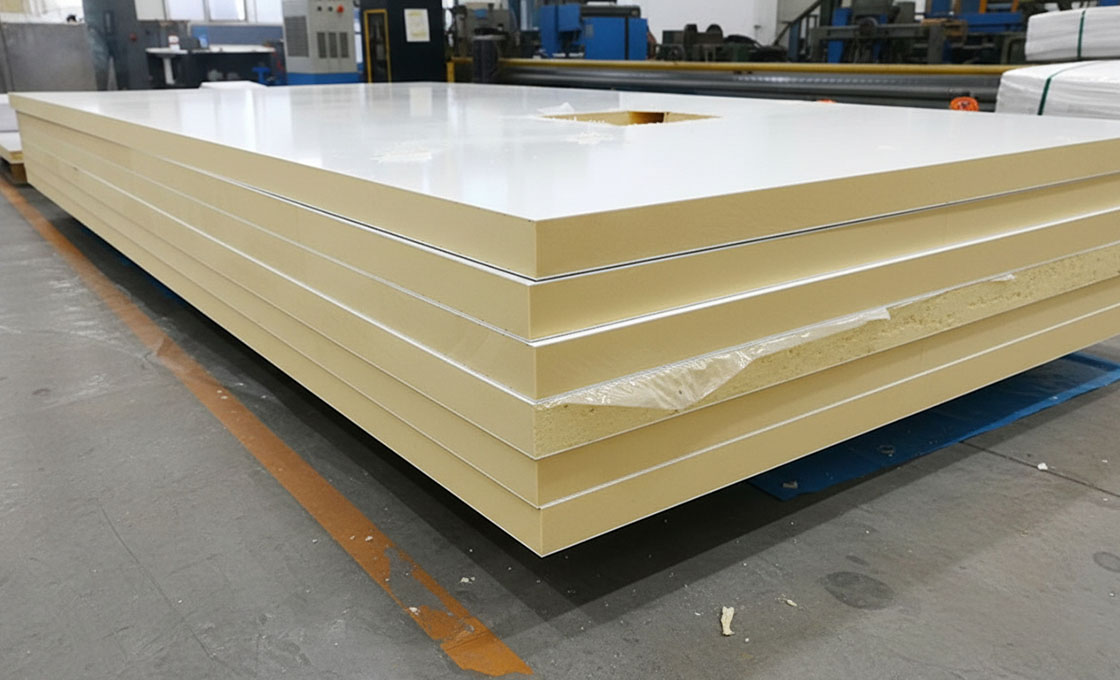
Container loading optimization is where volume buyers see the greatest cost leverage. A 40-foot high-cube container holds approximately 28 to 32 cubic meters of IMP wall panels, depending on panel thickness and packaging style. Optimizing the stack orientation—laying panels flat with edge-protected spacers and strapping every three layers—maximizes payload while preventing edge damage during transit. For full-container-load (FCL) shipments, a single container can supply panels for roughly 8 to 12 RV wall builds, depending on floorplan complexity.
- Lead-Time Tiers: Standard panels (25mm, 30mm, 40mm, common widths) ship within 14–21 days; custom profiles or specialty cores require 28–35 days due to tooling and cure-time adjustments.
- Container Utilization: Optimized flat-stack loading achieves 92 to 96% container volume utilization, reducing per-square-meter ocean freight cost by 8 to 12% compared to inefficient packing.
- Ocean-Freight Protection: Edge protectors, moisture-barrier wrapping, and steel strapping at 600mm intervals prevent panel face damage and core compression during sea transit.
- Partial Shipment Scheduling: For large orders, splitting shipments into 2-to-3 weekly partial loads keeps the assembly line stocked without requiring full-container commitment per shipment.
Volume-Based Production Scheduling That Aligns with RV Assembly-Line Throughput
An RV assembly line typically runs at a cadence of 3 to 8 units per day, depending on plant size and model mix. Each RV wall requires approximately 18 to 28 square meters of IMP panels, meaning a single assembly line consumes 54 to 224 square meters of panels per day. The IMP manufacturer must schedule production to match this consumption rate without creating excess WIP (work-in-progress) inventory that ties up floor space and capital.
Volume-based scheduling works best when the OEM and manufacturer share a rolling 60-day demand forecast. The manufacturer reserves dedicated line time for the OEM’s panel sizes and cores, converting the forecast into a weekly production schedule that feeds directly into shipping schedules. This approach eliminates the bottleneck of rush orders and ensures that the most frequently ordered panel dimensions—typically 600mm and 1,200mm widths at 25mm, 30mm, and 40mm thicknesses—are always in stock or near-stock at the factory.
- Rolling Forecast Alignment: A 60-day rolling forecast shared between OEM and manufacturer enables production slots to be reserved, reducing expediting costs and preventing schedule displacement.
- Dedicated Line Time: High-volume OEMs secure reserved production capacity during peak seasons (typically Q2 and Q3 for North American RV manufacturers), guaranteeing delivery even when the factory runs at full utilization.
- Buffer Inventory Strategy: Maintaining a 7-to-14-day buffer of the OEM’s top 5 most-used panel configurations at the factory or a nearby 3PL warehouse absorbs demand spikes without disrupting the production schedule.
- Assembly-Line Synchronization: Weekly shipping schedules aligned to the OEM’s build plan—rather than batch shipments every 30 days—reduce the OEM’s on-site storage requirements and improve cash flow.
📋 Actionable Steps
- Step 1: Share your 12-month production forecast with the IMP manufacturer, broken down by quarter and panel configuration, to secure dedicated line time and pricing stability.
- Step 2: Negotiate a volume-commitment agreement that guarantees container-loading priority during peak manufacturing seasons and defines penalty terms for missed lead times.
- Step 3: Establish a weekly shipment cadence rather than monthly batch shipments to keep your assembly line stocked with minimal on-site inventory.
Choosing an IMP Manufacturer: What Really Matters
The right IMP manufacturer isn’t chosen on unit price alone. RV producers who lock in long-term partnerships evaluate three dimensions: engineering support depth, quality certification rigor, and supply chain reliability under volume and seasonality stress.
Evaluating Engineering Support and Custom Design Capabilities
Insulated metal panels for RV applications are rarely off-the-shelf products. Floorplan variations, curved wall sections, roof contours, and cutouts for vents, solar mounts, and window assemblies require a manufacturer that operates as an engineering partner—not just a fabricator. The evaluation should begin with how closely the manufacturer’s technical team integrates with your design workflow.
Strong engineering support manifests in three observable ways. First, the availability of detailed technical documentation including panel cross-section diagrams, thermal bridging analysis, and fastener schedule recommendations. Second, the ability to produce custom panel geometries—tapered thicknesses, integrated channels, or multi-radius curves—without requiring redesign of your assembly process. Third, the responsiveness of the engineering team during the prototyping phase, particularly when resolving fitment conflicts between the panel system and other RV components.
- Technical documentation depth: Look for manufacturers that provide full cross-section drawings, thermal performance data sheets, and installation guidance documents before the first order is placed.
- Custom geometry capability: Evaluate whether the manufacturer can produce panels with variable thickness, integrated mounting channels, and complex cutouts using CNC precision, rather than requiring field modification.
- Prototyping turnaround: A responsive engineering team should deliver prototype panels within 10 to 15 business days for standard configurations, with longer timelines clearly communicated for custom runs.
Assessing Production Infrastructure and Quality-Certification Standards
Production infrastructure determines whether a manufacturer can deliver consistent panel quality at volume. The critical assessment points are not the size of the facility but the sophistication of the lamination process control, the precision of panel cutting equipment, and the rigor of in-line quality inspection.
For RV applications, the lamination process must maintain consistent core-to-skin bond integrity across the entire panel surface. Delamination is the single most costly failure mode in insulated metal panels, and it originates from process variability during bonding—not from material defects alone. Manufacturers that invest in automated lamination lines with real-time pressure and temperature monitoring significantly reduce this risk compared to facilities relying on manual or semi-automated processes.
<p style<What IMP Warranties and After-Sales Support Cover
Delamination Protection Terms for Core Bonding
Insulated metal panel (IMP) warranties in the RV sector typically address core-to-face delamination, a failure mode caused by moisture ingress, thermal cycling, or mechanical vibration. Standard industry warranties often range from 10 to 20 years, but the specific coverage for core bonding varies significantly by manufacturer. Claims are generally evaluated through bond‑strength testing and inspection of installation practices, with exclusions for improper fastening or unapproved sealants.
At Rax Panel, we structure our delamination protection terms around rigorous core‑to‑face bonding protocols. Our production line utilizes a range of core materials—including XPS, PET, PU, PVC, PMI, EPP, and MPP foams, as well as PP, aramid, and PC honeycomb cores—paired with facing sheets such as GRP/FRP, CFRT, aluminum, steel, ACP, plywood, and stainless steel. Each material combination is selected for its compatibility and bond integrity under the dynamic loads of road‑rated RV construction.
Delamination remains the single most costly failure mode in lightweight RV panel systems, which is why warranty terms must be anchored to verifiable bond-integrity data. Our warranty coverage is specifically tied to bond-integrity testing performed across every core‑to‑facing material combination we produce—including XPS, PET, PU, PVC, PMI, EPP, and MPP foams paired with PP, aramid, and PC honeycomb cores, and facings such as GRP/FRP, CFRT, aluminum, steel, ACP, plywood, and stainless steel—ensuring each configuration is validated under dynamic road‑load conditions before it qualifies for warranty protection. This material‑specific approach means delamination claims are evaluated against the bond‑integrity benchmarks established for the exact core and facing combination in the panel, excluding damage caused by post‑manufacturing modification or improper installation.
- Core‑Bonding Integrity: Warranties cover failures originating from the adhesive bond between the core material and the face sheet, excluding damage caused by post‑manufacturing modification or improper installation.
- Material‑Specific Testing: Each core‑facing combination (e.g., CFRT with XPS foam, GRP with PET foam, aluminum with honeycomb core) is validated through laboratory shear and peel tests before production approval.
- Exclusion Clauses: Delamination resulting from unauthorized drilling, incorrect sealant application, or exposure to temperatures beyond the panel’s rated threshold is not covered.
Many warranty disputes arise from improper field installation rather than manufacturing defects. Ensure your installation team follows the manufacturer’s guidelines for edge sealing, fastener spacing, and thermal expansion gaps to maintain warranty validity.
Global Supply Chain Risk Management
Sourcing IMPs for RV production introduces supply‑chain risks such as lead‑time delays, ocean‑freight disruptions, batch‑to‑batch quality variation, and customs clearance hurdles. OEMs typically mitigate these risks through dual‑sourcing strategies, safety stock inventory, and stringent incoming‑quality inspections. The geographic location of the manufacturer also affects logistics costs and delivery reliability.
Rax Panel manages global supply‑chain risk through our integrated manufacturing facility and over 15 years of production experience. Our advanced composite panel production line exceeds 1,700 square meters of daily output, allowing us to maintain consistent quality and meet large‑volume orders for RV wall, roofing, flooring, and furniture panels. We have established long‑term supply‑chain cooperation with over 50 countries and regions, serving manufacturers and distributors across Europe, North America, South America, Southeast Asia, Central Asia, Japan, South Korea, and the Middle East.
Bulk RV panel orders demand more than consistent output—they require synchronized scheduling that tracks every shipment against your assembly-line cadence. Leveraging over 15 years of production experience and a logistics network spanning 50+ countries, Rax Panel actively mitigates ocean-freight delays and optimizes container-loading configurations to secure your supply chain. We enforce strict engineering standards to ensure batch-to-batch thickness tolerances remain within ±0.5mm, preventing fitment issues for large-volume RV orders. This logistics-centric execution ensures that bulk-order scheduling is precisely aligned with your assembly-line throughput, so materials arrive exactly when needed without disruption.
- Production Consistency: In‑line quality monitoring at each stage—from core‑foam extrusion to face‑sheet lamination—minimizes batch‑to‑batch variation in panel thickness, density, and thermal resistance.
- Logistics Optimization: Container‑loading plans are engineered to maximize volume utilization while protecting panels from moisture and impact during ocean transit.
- Multi‑Language Support: Sales and engineering staff fluent in English, French, Russian, Japanese, and Korean provide seamless communication across time zones.
Post‑Sale Engineering Consultation Availability
After‑sales engineering support is a critical differentiator for IMP purchasers. Beyond basic installation guides, buyers need access to technical experts who can advise on panel selection, structural integration, and performance troubleshooting throughout the vehicle’s service life. Manufacturers with limited post‑sale resources often leave builders to resolve field issues independently.
At Rax Panel, our team of engineers deeply understands customer project needs and provides post‑sale engineering consultation availability. We conduct experimental testing to develop composite products that meet various data standards, and we continue to support our clients after shipment with guidance on installation best practices, design modifications, and performance optimization for RV applications.
Our 24‑hour one‑to‑one service covers product design review, production‑progress updates, cost‑reduction strategies, and transportation‑risk management. This continuous engagement ensures that any technical questions or field challenges are addressed promptly by professionals who are familiar with the panel’s original specification and testing history.
- Installation Guidance: Detailed instructions for edge sealing, fastener patterns, and thermal‑expansion detailing specific to RV wall, roof, and floor assemblies.
- Design Consultation: Engineering review of panel configurations for custom floorplans, ensuring structural rigidity and thermal performance meet project requirements.
- Warranty Claim Support: Step‑by‑step assistance in documenting and submitting warranty claims, including guidance on required inspection photos and test reports.
When evaluating an IMP manufacturer, request a clear post‑sale support charter that outlines response times, available technical resources, and the scope of engineering consultation. Manufacturers that provide dedicated 24‑hour one‑to‑one service demonstrate a commitment to long‑term partnership beyond the initial sale.
Conclusion
Switching to insulated metal panels isn’t just about weight reduction — it’s about locking in thermal performance and structural integrity across every floorplan you build. Traditional wood framing and fiberglass create variables that compound over time: moisture intrusion, delamination, and R-value drift. IMPs eliminate those variables by bonding aluminum facings directly to PIR or mineral wool cores in a controlled environment. The result is a panel that holds its R-value, resists vibration fatigue, and meets fire ratings without secondary treatments.
- Request delamination warranty documentation and third-party test reports before committing to a supplier.
- Our engineers review panel specs against your floorplan tolerances at no charge during the design phase.
- Schedule a technical consultation to walk through thermal bridging calculations for your specific RV class.
Frequently Asked Questions
Foam core vs honeycomb core: which suits RVs better?
Foam cores like XPS, PET, and PU deliver superior thermal insulation and are moisture-resistant, making them the standard choice for RV walls and roofing. Honeycomb cores, including PP and fiberglass variants, provide exceptional rigidity and impact resistance at very low weights but offer less insulation. Many RV manufacturers combine both—foam cores for insulation zones and honeycomb cores for high-stress structural areas.
Can IMPs replace Azdel or other thermoplastic panels in RVs?
Yes. IMPs with CFRT or LWRT facings serve as direct replacements for thermoplastic composite panels like Azdel in RV wall and roof construction. They deliver comparable or superior weight reduction while adding integrated thermal insulation in a single panel, eliminating the need for separate insulation layers. This simplifies assembly and reduces overall panel thickness.
What R-value can I expect from IMP cores in RV walls?
R-values vary by core material and panel thickness. PET foam cores typically deliver R-5 to R-6 per inch, XPS around R-5 per inch, and PU foams range from R-6 to R-7 per inch. For a standard 1.5-inch RV wall panel, expect an effective R-value between R-7 and R-10 depending on the core selected and facing material.
How do IMPs handle extreme temperature swings on the road?
IMP cores such as PET, XPS, and PIR maintain stable thermal performance across wide temperature ranges without significant degradation. The bonded metal or composite facings prevent core exposure to moisture and UV, which are the primary causes of insulation breakdown in traditional RV panels. This ensures consistent R-value retention from desert heat to cold-weather travel.
What certifications should RV IMPs meet for North America?
For North American RV markets, IMPs should carry UL 94 HB fire ratings or higher, particularly for PIR and mineral wool cores. Certifications such as CE marking support European compliance, while third-party test reports for structural load, delamination resistance, and moisture absorption are essential for OEM procurement. RaxPanel provides full technical documentation and test reporting to support these requirements.
How do IMPs integrate with existing RV assembly lines?
IMPs are designed for straightforward integration into standard RV manufacturing workflows. Their modular dimensions and precision CNC-cut profiles allow them to be installed using conventional fastening and adhesive methods already used in RV production. RaxPanel provides installation guides and engineering support to ensure seamless adoption without requiring new tooling or process changes.
What thickness options are available for RV IMPs?
RV IMPs are commonly available in thicknesses ranging from 20mm to 50mm, with 25mm, 30mm, and 40mm being the most popular for walls, roofing, and flooring respectively. Custom thicknesses can be produced to match specific structural or insulation requirements. Panel width and length are also customizable to minimize on-site waste and optimize container loading.